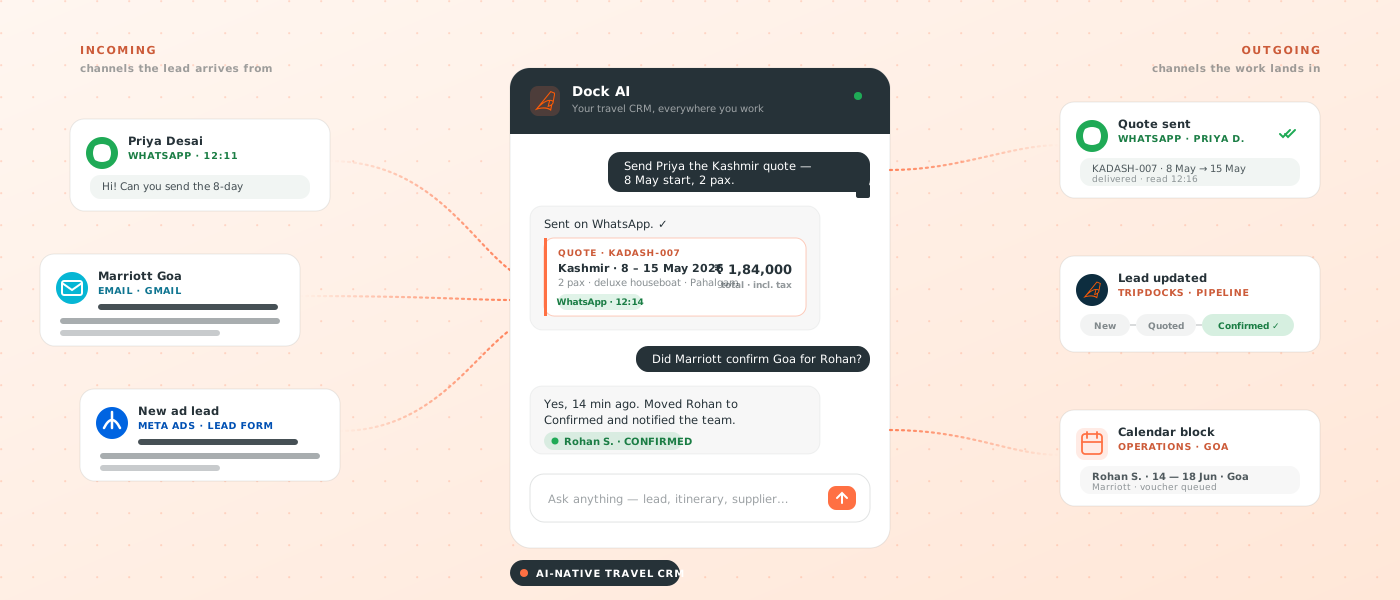
The way people operate software is moving off the screen. Assistants, messaging apps, and agentic tools are becoming the layer work actually happens in — and a CRM that can only be driven from its own browser tab is becoming the friction, not the workspace. That shift is the entire reason Tripdocks exists, and it is the lens this blog will keep coming back to.
This is a point of view, written early and on purpose. It is not a feature announcement. Where Tripdocks does something today, this post says so plainly; where it describes a direction, it says that just as plainly.
The interface to software is changing
For two decades, “using a CRM” meant opening the CRM. You logged in, you found the record, you did the thing inside the product’s screens. The screen was the system.
That assumption is quietly breaking. People increasingly start work from an assistant or a conversation, not an application. Tool use and function calling let assistants take real actions in other systems. Agentic workflows chain those actions together. The interface layer is moving up and out — toward the place a person already has open, whether that’s a chat thread, a messaging app, or an AI assistant.
For most software categories this is a convenience. For travel operations, where the work is already spread across WhatsApp, email, and phones, it is closer to a structural shift.
Why legacy CRMs are stuck
The hard part isn’t adding an “AI feature.” It’s that most legacy CRMs were built as closed user interfaces, with data models shaped for screens rather than for programmatic or assistant-driven access.
A chat box bolted onto a system that was never meant to be reached programmatically doesn't make it AI-native. It makes it a chat box.
When the system can’t be reached cleanly from outside itself, every “AI” addition stays trapped behind the same wall as everything else. The product can describe itself to a user; it can’t be operated from where the user actually is.
What “AI-native” actually means
AI-native is not a chatbot in the corner of a dashboard. It’s a design stance about access. Concretely, it means a few things:
- The system is reachable from where you work — not only from its own UI, but from the assistant, channel, or tool a team already has open.
- Data and actions are first-class, not screen-only — a lead, a quote, a follow-up are things that can be read and acted on programmatically, not just clicked.
- The premium in-product experience still matters — being operable from elsewhere does not mean abandoning a focused, well-designed workspace. It means the workspace is one surface, not the only one.
Named concretely: a travel team lives in WhatsApp with clients, in email with suppliers, and increasingly alongside an AI assistant for the busywork. “AI-native” means the CRM is designed so it can meet work in those places — wherever the team already is — instead of demanding everyone come back to one tab. We’re using those channels as illustrations of the principle, not publishing a feature list.
Where Tripdocks stands today
Honesty matters more than ambition here, so this section is deliberately narrow.
Today, Tripdocks is in early access, available via demo. What exists now is a travel CRM with integration-first lead capture — WhatsApp Business, Meta Ads, and webhooks — landing in one queue, with the lead-to-booking workflow as the core model rather than a generic contact database.
What this post describes — operating the CRM from external AI assistants and channels — is the direction, not a shipped capability and not a dated promise. The reason to say the thesis out loud now is that it shapes every design decision being made today: build for access, not just for screens.
| Aspect | Shipped today | The direction |
|---|---|---|
| Lead capture | WhatsApp, Meta Ads, webhooks → one queue | Reachable from more of where teams work |
| Core model | Lead-to-booking workflow, not a contact list | Actions usable beyond the UI |
| Access | Web workspace, integration-first build | Operable alongside assistants and channels |
What this means for travel teams
If you run a travel business, you don’t need to care about any of this in the abstract. You need fewer leads slipping through the gaps, and less time spent re-typing the same trip into three places. The reason the AI-native framing matters is that it points at why those problems persist: the tools were built to be visited, not to be operated from where the work already is.
The travel ecosystem is going to keep moving toward assistant-driven, low-friction daily work — the busywork getting quietly absorbed rather than manually pushed around. Software that was built before that shift will keep struggling to meet teams there. That gap is the thing worth building for, and it’s what the rest of this blog will keep examining.
For the category background, see what is a travel CRM, the glossary for the terms used here, or the documentation for what’s live today.
Frequently asked
The questions people actually ask.
What does 'AI-native' mean for a CRM?
An AI-native CRM is designed so its data and actions can be reached programmatically and through AI assistants — not locked behind a single web UI. The goal is to operate the system from where work already happens, not to bolt a chatbot onto an old database.
Can I operate Tripdocks from ChatGPT, Claude, or Slack today?
Not today. That is the direction Tripdocks is building toward, not a shipped feature. Today Tripdocks is in early access and integration-first, with WhatsApp Business, Meta Ads, and webhook lead capture. This article describes the thesis, not a current capability or a dated roadmap.
Why can't legacy travel CRMs just add an AI feature?
Most were designed as closed UIs with data models built for screens, not for programmatic or assistant access. Adding a chat box on top does not make the underlying system reachable in the way agentic and assistant-driven workflows need.
Is this just hype about AI?
The specific shifts referenced here — assistants as an interface layer, tool use, and agentic workflows — are real and widely adopted. What Tripdocks claims today stays narrow and honest: the product is early, and AI-operability is a direction we're building toward.